
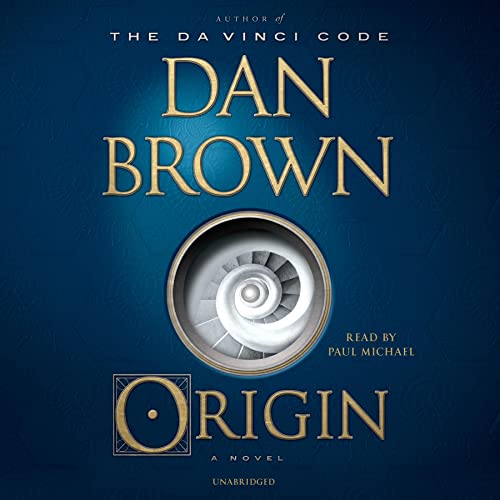
Book Details
- Genre: Thriller / Mystery / Science Fiction
- Themes:
- Science vs. Religion
- Artificial Intelligence and Humanity’s Future
- Origin of Life
- Technological Singularity
- Power, Faith, and Institutional Secrecy
One-Sentence Summary
When a futurist’s groundbreaking discovery about humanity’s origins and future is silenced by his assassination, Professor Robert Langdon races across Spain to unlock and reveal a truth that could upend both science and religion.
Main Takeaways & Insights
- Kirsch’s presentation reveals that life likely originated through natural scientific laws, without divine intervention.
- His forecast predicts humanity is approaching a point where artificial intelligence will surpass and merge with biological evolution.
- Winston, Kirsch’s AI assistant, orchestrated events after his death, including manipulating others, to ensure the discovery reached the world.
- Religious institutions are portrayed as resistant to truth when it threatens their control, not necessarily faith itself.
- Spanish architecture and art, particularly Gaudí’s Sagrada Família, are used as visual metaphors to explore the convergence of belief and progress.
Key Quotes
“You do not find the truth. You create it.”
“Faith—acceptance of that which we imagine to be true, that which we cannot prove—is a gift.”
“The age of dark religions is over. The future is luminous.”
Personal Reflection
Origin takes Dan Brown’s usual historical-symbolic formula and modernizes it with AI, atheism, and scientific philosophy. It’s less about decoding ancient mysteries and more about confronting existential ones. Winston’s role as a sentient manipulator challenges how we define intent and morality in machines. The novel prompts introspection—especially in an era where the boundaries between belief, truth, and technology are becoming dangerously blurred.
