
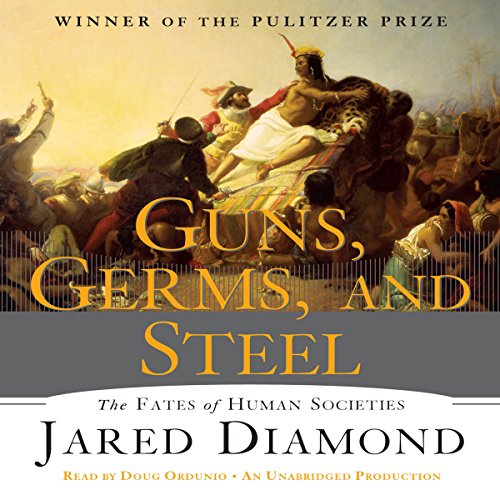
Book Details
- Genre: Non-Fiction / History / Anthropology
- Themes:
- Geographic Determinism
- Agricultural Origins and Domestication
- Technology and Imperialism
- Disease as a Historical Force
- Inequality Between Civilizations
One-Sentence Summary
Guns, Germs, and Steel argues that environmental and geographic factors—not racial or cultural superiority—determined the unequal development of societies throughout history.
Main Takeaways & Insights
- Geography, Not Biology, Drove History: Societies developed differently not because of intelligence or ambition, but due to environmental advantages such as access to domesticable plants and animals.
- The East-West Axis Advantage: Eurasia’s orientation allowed for easier diffusion of agriculture, technology, and culture, compared to the north-south axes of Africa and the Americas.
- Agriculture Created Surpluses and Specialization: Food production enabled population growth, social stratification, and innovation, giving rise to complex societies and organized states.
- Germs Decided Wars Before Guns Did: Diseases like smallpox decimated indigenous populations long before Europeans established control, giving invaders biological advantages alongside military ones.
- Technology and Writing Amplified Power: The accumulation of knowledge—through writing, metallurgy, and political organization—further entrenched the dominance of some civilizations.
- Rejecting Racist Explanations: Diamond systematically dismantles the myth of racial superiority and instead places the roots of inequality in material and environmental conditions.
Key Quotes
“History followed different courses for different peoples because of differences among peoples’ environments, not because of biological differences among peoples themselves.”
“Technology, writing, centralized government, and organized religion all arose from the surpluses generated by food production.”
“Civilization arose not out of superior brains, but out of favorable geography.”
Personal Reflection
This book redefined how I think about human history. Diamond’s core argument is as unsettling as it is empowering—it removes the veil of cultural superiority and forces us to grapple with the deep influence of chance and geography. It’s dense in parts, but absolutely worth the intellectual effort. The true brilliance lies in how it challenges our assumptions without moralizing, giving readers the tools to rethink history on structural, not superficial, terms.
