
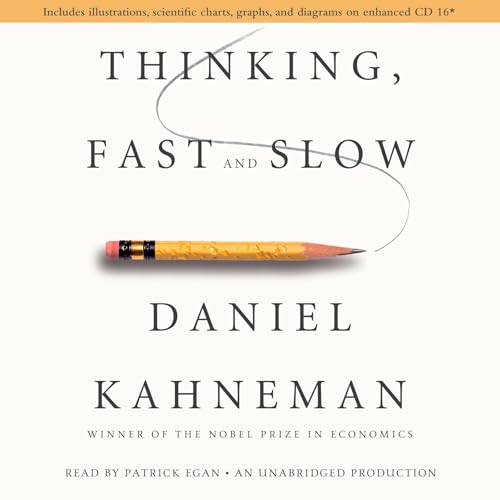
Book Details
- Genre: Non-Fiction / Psychology / Behavioral Economics
- Themes:
- Cognitive Biases
- Dual-System Thinking
- Judgment and Decision-Making
- Rationality vs. Intuition
- Behavioral Economics Foundations
One-Sentence Summary
Thinking, Fast and Slow explores the two systems that drive the way we think—fast, intuitive thinking and slow, deliberate reasoning—and how these systems influence judgment, decision-making, and human error.
Main Takeaways & Insights
- Two Systems of Thought:
- System 1 is fast, automatic, emotional, and intuitive.
- System 2 is slow, effortful, logical, and deliberative. Most of our decisions rely on System 1, which is efficient but often flawed.
- Cognitive Biases Are Pervasive: Heuristics and mental shortcuts lead to consistent judgment errors, including anchoring, availability bias, and representativeness.
- Overconfidence and Illusions of Understanding: People consistently overestimate what they know, misunderstand probabilities, and seek coherence over truth.
- Loss Aversion: Losses loom larger than gains—people are more sensitive to losing $100 than they are to gaining $100, which drives risk-averse or irrational behavior.
- Framing Matters: The way a problem or choice is framed significantly affects the decision outcome, even if the underlying information is the same.
- Prospect Theory: Kahneman and Tversky’s landmark theory explains how people actually make decisions under risk, challenging traditional economic models of rational behavior.
Key Quotes
“Nothing in life is as important as you think it is, while you are thinking about it.”
“We can be blind to the obvious, and we are also blind to our blindness.”
“A reliable way to make people believe in falsehoods is frequent repetition, because familiarity is not easily distinguished from truth.”
Personal Reflection
Thinking, Fast and Slow is both dense and brilliant—a cognitive mirror held up to our own minds. Kahneman doesn’t just inform; he dissects the very act of thinking, exposing how little control we truly have over our mental shortcuts. It’s not a book you casually read; it’s one you wrestle with and return to. The biggest takeaway for me? Knowing about our biases doesn’t eliminate them—but it can make us more humble, methodical, and aware.
