
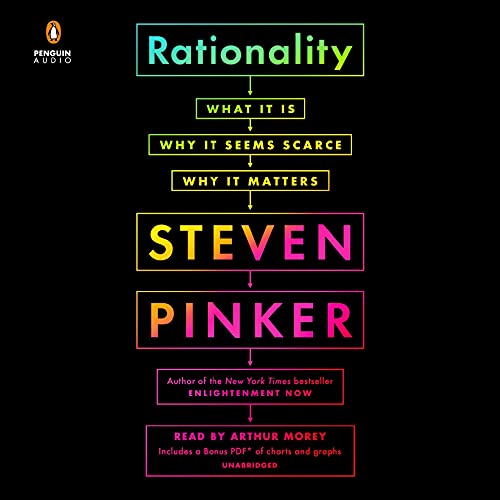
Book Details
- Genre: Non-Fiction / Psychology / Philosophy
- Themes:
- Rational Thinking & Cognitive Bias
- Logic and Critical Thinking
- The Enlightenment and Scientific Reason
- Probability, Statistics, and Decision Theory
- Rational Discourse in Society
One-Sentence Summary
Steven Pinker explores why humans often fail to think rationally despite having the capacity for logic and reason, and argues that promoting rationality is vital for personal decisions, policy-making, and societal progress.
Main Takeaways & Insights
- Humans Are Capable—but Not Always Practicing—Rationality: Our minds evolved for survival, not truth-seeking, which leads to systematic biases and intuitive errors.
- Cognitive Tools Are Learnable: Concepts from logic, probability, correlation vs. causation, Bayesian reasoning, and game theory can be taught and applied to improve decision-making.
- Biases vs. Heuristics: Heuristics aren’t always irrational; context matters. What seems irrational in one setting may be adaptive in another.
- Rationality in the Modern World: The seeming scarcity of rationality isn’t due to a lack of intelligence but often social influences—identity, tribalism, and motivated reasoning.
- Rationality Drives Progress: Societies that embrace reason, science, and open debate tend to advance in health, rights, and prosperity.
Key Quotes
“Rationality ought not to be a synonym for intelligence.”
“People don’t believe in things because they are rational; they believe in things because they fit their group’s narrative.”
“Understanding rationality helps inoculate us against the mind bugs that mislead our reasoning.”
Personal Reflection
Rationality is Pinker’s ambitious attempt to defend reason in an age often dominated by misinformation, tribal politics, and anti-science rhetoric. He doesn’t romanticize human thinking but instead builds a compelling case for why rationality must be taught, practiced, and celebrated. The book serves both as a toolkit for better thinking and a manifesto for a more reasoned world. It’s timely, necessary, and intellectually invigorating.
