
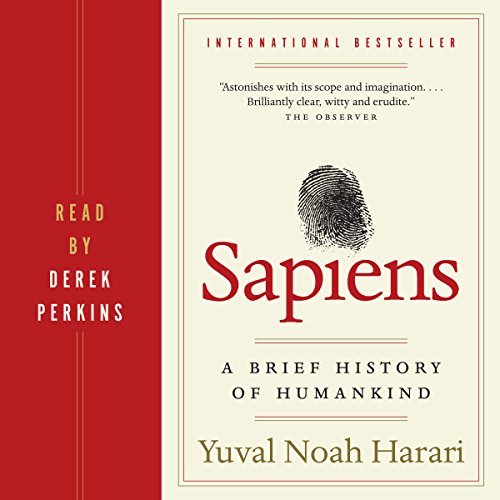
Book Details
- Genre: Anthropology / History / Evolutionary Sociology
- Narrator: Derek Perkins (audiobook)
- Themes:
- Cognitive and Agricultural Revolutions
- Myth-making and collective belief
- Human cooperation and domination
- Capitalism, religion, and science
- The future of Homo sapiens
One-Sentence Summary
Harari traces the sweeping journey of Homo sapiens from insignificant apes to the architects of global civilization, examining how biology, belief, and storytelling enabled our species to dominate the planet.
Main Takeaways & Insights
- The Cognitive Revolution (~70,000 years ago): What set sapiens apart wasn’t physical strength, but the unique ability to imagine, believe in shared myths, and communicate ideas at scale—laying the foundation for cooperation beyond kinship.
- Shared Fictions Run the World: Constructs like money, corporations, religions, and nations are intersubjective realities—entirely invented, yet powerful because enough people believe in them.
- The Agricultural Revolution: Harari provocatively argues it was history’s biggest fraud: while it allowed population growth, it also led to harder labor, worse diets, and hierarchical societies.
- Unification of Humankind: Through empire-building, trade, and religion, humans began converging into a single global society—marked by cooperation, competition, and conquest.
- The Scientific Revolution (~500 years ago): Unlike previous eras that sought certainty, this period embraced ignorance—fueling rapid discovery, capitalism, industrialization, and unprecedented control over nature.
- Capitalism & Consumerism: Harari critiques how modern economies rely not just on production, but endless consumption—driven by invented desires and identities.
- The Human Dilemma: Despite immense progress, sapiens remain unsure if they’re happier. Technological mastery hasn’t solved existential suffering, and the future may usher in post-human evolution.
Key Quotes
“History began when humans invented gods, and will end when humans become gods.”
“Culture tends to argue that it forbids only that which is unnatural. But from a biological perspective, nothing is unnatural.”
“You could never convince a monkey to give you a banana by promising him limitless bananas after death in monkey heaven.”
Personal Reflection
Sapiens is a cerebral punch—equal parts fascinating and discomforting. Harari’s detached tone helps him cut through human ego with surgical precision, exposing the scaffolding of our reality as myth upon myth. While some arguments are debatable in depth, the clarity and ambition of his narrative are undeniable. It’s a book that forces readers to question the foundations of their identity, values, and society at large. An essential read for those willing to confront the possibility that what holds the world together is not truth, but agreement.
