
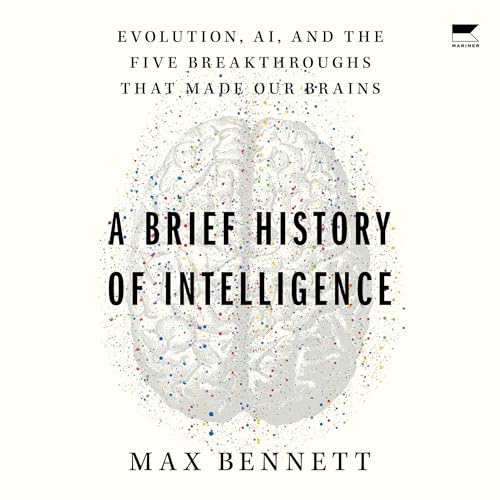
Book Details
• Genre: Neuroscience / Evolutionary Biology / Artificial Intelligence
• Narrator: Max S. Bennett (audiobook)
• Themes:
• Evolution of Cognitive Functions
• AI’s Relation to Biological Intelligence
• The Architecture of the Brain
• Consciousness and Computation
• Human Uniqueness vs. Machine Replication
One-Sentence Summary
Max S. Bennett traces the evolutionary milestones that shaped human intelligence and argues that understanding these breakthroughs is key to both decoding our minds and advancing artificial intelligence in a meaningful way.
Main Takeaways & Insights
• Five Breakthroughs Defined Intelligence: Bennett identifies five evolutionary milestones—life, neurons, learning, symbols, and abstraction—that form the core architecture of intelligence.
• Brains as Biological Computers: While the brain is not a computer in the traditional sense, its layered evolution shares principles that mirror computational logic, useful in AI design.
• AI Must Emulate Evolution, Not Just Computation: For AI to reach human-like cognition, it must replicate the brain’s ability to abstract and synthesize, not just process data.
• Symbolic Reasoning Sets Humans Apart: The leap from learned associations to using and creating symbols was critical in setting Homo sapiens apart from other species.
• The Future Lies in Integrating Disciplines: Bridging neuroscience, evolutionary theory, and computer science offers the most promising path for advancing both cognitive science and artificial intelligence.
Key Quotes
“Intelligence didn’t emerge fully formed—it evolved in layers, over billions of years.”
“Understanding the architecture of the brain is not just a scientific pursuit; it’s a map for building machines that think.”
“Artificial intelligence that ignores biology is like building a rocket without understanding gravity.”
“The brain is the most elegant solution evolution ever engineered.”
Personal Reflection
Bennett offers a compelling fusion of hard science and speculative thought, revealing not only how our brains came to be, but also how this journey might inform the machines we build. Unlike many tech-centric books, this one roots its insights in biology and evolution, giving it both intellectual weight and visionary scope. For readers and listeners interested in how natural intelligence informs artificial design, this is essential material. The audiobook, narrated by the author, carries a tone of both authority and wonder that enriches the experience.
