
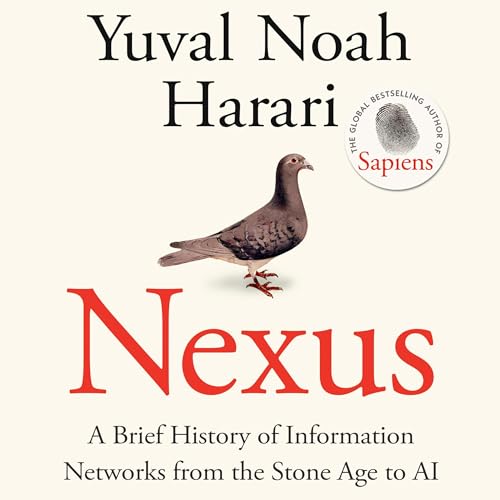
Book Details
• Genre: Non-Fiction, History, Technology, Sociology
• Narrator: Yuval Noah Harari (varies by edition)
• Themes:
• Information as Power
• Evolution of Communication
• Networks and Empires
• Data, AI, and the Future of Humanity
• Myth, Meaning, and Mass Coordination
One-Sentence Summary
Nexus explores how human civilization has been shaped by information networks—from ancient gossip and religious texts to modern data flows and artificial intelligence—arguing that whoever controls the network, controls the world.
Main Takeaways & Insights
• Networks Define History
Harari shows that historical power often stemmed from the ability to control narratives and manage collective information—from priests and kings to tech corporations and algorithms.
• Gossip to Google
Human language evolved not merely for survival, but to share stories and build large-scale cooperation; modern tech platforms are the digital successors of tribal campfires.
• Empires Are Built on Information
Empires such as Rome, the British Empire, and today’s global powers rely on the seamless flow and control of information across vast distances.
• AI as Ultimate Network Authority
Artificial intelligence represents a new kind of network—a self-learning, predictive force that could centralize control or democratize access, depending on its stewardship.
• Meaning vs. Data
The more information we produce, the more critical interpretation becomes; raw data without wisdom is noise, and humanity’s challenge is to make sense of it all.
Key Quotes
“Those who control the flow of information control the fate of civilizations.”
“Humanity’s superpower is not intelligence, but the ability to believe collective fictions.”
“Every empire is a network of imagination, sustained by scribes, symbols, and stories.”
“In the age of AI, data is the new deity.”
“Freedom in the information age means knowing who is programming your thoughts.”
Personal Reflection
Harari excels at distilling vast swaths of human history into lucid, provocative insights—and Nexus may be his most relevant yet. It’s not just a chronicle of past innovations, but a wake-up call about the structures shaping our present. As information becomes the world’s most valuable resource, the question isn’t just who owns the data, but who decides what it means. The book reminds us that our institutions, myths, and even selves are built on stories we choose to share. Understanding networks isn’t optional—it’s essential for navigating the future.
