
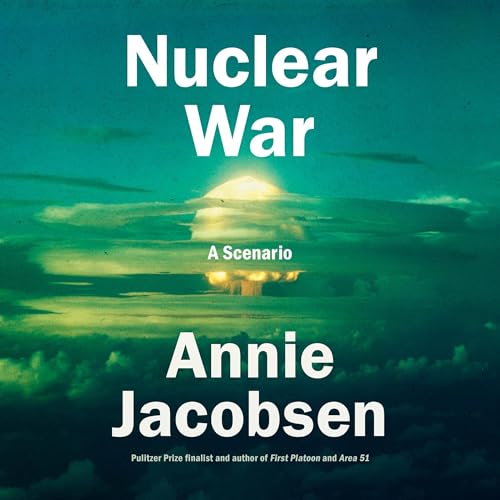
Book Details:
• Genre: Non-Fiction, Geopolitics, Military Strategy
• Narrator: Annie Jacobsen
• Themes:
• Chain of Command in Crisis
• Deterrence vs. Brinkmanship
• Civil Defense and Unpreparedness
• Technological Vulnerabilities
• The Irreversibility of Nuclear Decisions
One-Sentence Summary
Annie Jacobsen delivers a chilling minute-by-minute account of a hypothetical nuclear attack scenario on the United States, exposing the fragility of deterrence, the terrifying speed of escalation, and the devastating consequences of a real-world nuclear launch.
Main Takeaways & Insights
• Six Minutes to Decide
In the event of a confirmed incoming nuclear strike, the U.S. president has approximately six minutes to choose a response — a decision that could trigger global annihilation.
• Deterrence is Not Foolproof
The doctrine of Mutually Assured Destruction (MAD) relies on rational actors and perfect information, both of which are highly vulnerable to miscalculation, accidents, or rogue elements.
• Preparedness is Illusory
Despite decades of Cold War rhetoric, most governments, including the U.S., are vastly underprepared for the humanitarian, infrastructure, and environmental consequences of even a single detonation.
• Decentralized Chaos
As command structures collapse post-detonation, communication failures and cascading decisions lead to uncontrolled secondary attacks, reflecting how escalation spirals beyond any centralized control.
• Nuclear War is Not an Abstraction
Jacobsen stresses that nuclear conflict isn’t theoretical — it remains a very real possibility based on current global tensions, and public ignorance of its mechanisms is a danger in itself.
Key Quotes
“The president of the United States has six minutes to decide.”
“We live in a world where destruction travels faster than comprehension.”
“There is no undo button in nuclear war.”
“Mistakes are inevitable; annihilation doesn’t have to be.”
“This is not a prediction. It is a possibility.”
Personal Reflection
Jacobsen’s approach is stark and uncompromising — not speculative fiction, but an unsettling synthesis of actual policy, doctrine, and expert interviews presented as a plausible scenario. The granular timeline reinforces the fragility of systems we often assume are robust. The book avoids sensationalism, opting instead for an analytic horror: that every safeguard is built on a foundation of hope, not certainty. It’s a sobering reminder of how humanity lives under a Damoclean sword, one decision, misstep, or misread radar signal away from irrevocable catastrophe.
