
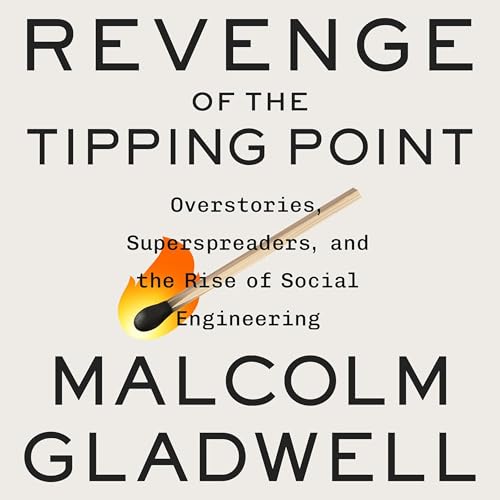
by Malcolm Gladwell
Book Details
- Genre: Social Psychology, Behavioral Science, Cultural Analysis
- Narrator: Malcolm Gladwell
- Themes: Contagion of ideas · Social engineering and manipulation · Influence of overstory narratives · Network effects and superspreaders · Ethics of persuasion and power
One-Sentence Summary
Gladwell revisits and expands on the original Tipping Point by exploring how powerful narratives, influencers, and engineered social conditions are now deliberately used to tip societies—sometimes for progress, often for control.
Main Takeaways & Insights
- Narratives Are the New Weapons In an age of overstimulation, people don’t just follow facts—they follow stories. Those who control the narrative can shift public behavior at scale.
- Superspreaders Are Not Just People, But Platforms Modern tipping points are driven by algorithmic gatekeepers and hyper-connected individuals, amplifying influence with unprecedented reach and precision.
- Overstories Shape Societies These deep cultural storylines—about freedom, security, success—anchor our beliefs. When manipulated, they can prime populations for engineered outcomes.
- Social Engineering Is Now a Profession From marketing to politics, behavior is no longer just observed—it’s actively shaped using data, psychology, and network science.
- The Ethics of Influence Are Eroding As tipping becomes intentional, the moral question shifts from “Can we do this?” to “Should we?”—a line that’s blurred more each day.
Key Quotes
“Influence has gone from accidental to architectural.” “We no longer stumble upon tipping points; we build them.” “The most powerful forces in society aren’t seen—they’re believed.” “In a networked world, persuasion scales faster than scrutiny.” “Contagion is no longer a metaphor—it’s a method.”
Personal Reflection
This is vintage Gladwell—curious, provocative, and layered with cultural insight—but now wielding a sharper edge. Revenge of the Tipping Point doesn’t just explain how change happens; it reveals how it’s increasingly designed. The book is a necessary wake-up call to examine not only the stories we believe but who benefits when we do. In a world of engineered virality and weaponized narratives, understanding the tipping point isn’t enough—we must question who’s tipping it, and why.
Leave a Reply