
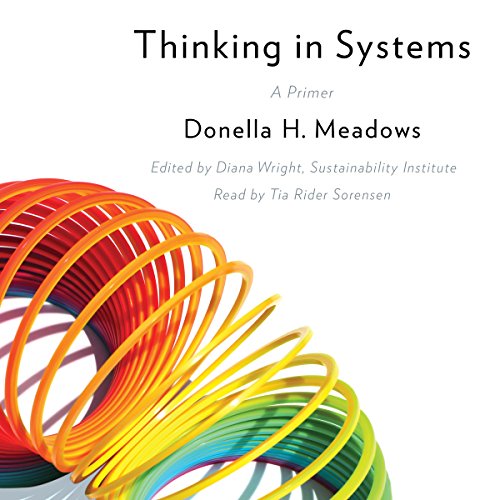
Book Details
• Genre: Systems Thinking, Environmental Science, Organizational Theory
• Narrator: Cassandra Campbell
• Themes:
• Feedback Loops and System Dynamics
• Leverage Points for Change
• Limits to Growth and Sustainability
• Mental Models and Perception
• Systemic Thinking in Policy and Society
One-Sentence Summary
This foundational guide introduces the core principles of systems thinking, emphasizing how feedback, delays, and leverage points shape complex systems—and how understanding these elements can lead to smarter decisions in everything from ecosystems to economies.
Main Takeaways & Insights
• Everything is a System
From ecological networks to financial markets, systems surround us, defined by interconnections, boundaries, and feedback loops.
• Feedback Loops Govern Change
Positive feedback reinforces change, while negative feedback stabilizes systems—understanding both is key to influencing behavior.
• Leverage Points Are Powerful—but Subtle
Small shifts in mindset or structure can produce dramatic changes in system behavior, especially when aimed at deep leverage points like paradigms.
• Growth Has Limits
Uncontrolled growth in finite systems leads to collapse; Meadows advocates for recognizing boundaries and aiming for sustainable equilibrium.
• Mental Models Shape Reality
Our assumptions about how systems work often blind us—systems thinking helps surface and revise these mental models for better decision-making.
Key Quotes
“A system is more than the sum of its parts.”
“Leverage points are places within a complex system where a small shift can produce big changes.”
“We can’t impose our will on a system; we can listen to what the system tells us, and discover how its properties and our values can work together.”
“Boundaries are of our own making, and that means we can take responsibility for them.”
“Systems thinking is a discipline for seeing wholes.”
Personal Reflection
Meadows’ clarity in presenting abstract ideas makes this not just a textbook but a manual for better thinking. The biggest impact of this book is epistemological—it forces a reevaluation of how we see causality, control, and change. It’s especially vital today, when the complexity of global challenges—from climate change to economic instability—demands systemic awareness. “Thinking in Systems” isn’t just a read—it’s a lens through which to view the world, offering both humility and actionable wisdom.
