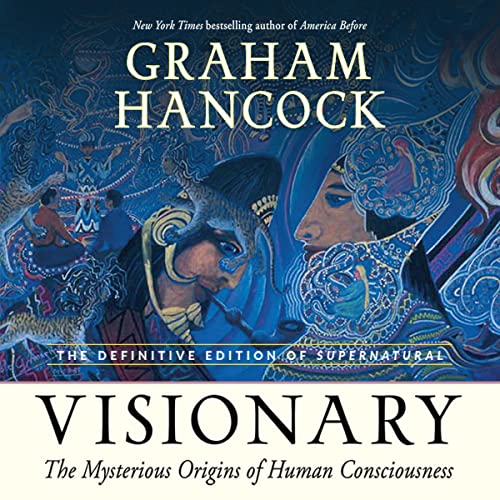
Book Details
• Genre: Alternative History, Consciousness Studies, Anthropology
• Narrator: Graham Hancock
• Themes:
• Origins of Human Consciousness
• Shamanism and Altered States
• Entheogens and the Spirit World
• Prehistoric Cave Art and Symbolism
• Reality, Myth, and the Human Psyche
One-Sentence Summary
Graham Hancock explores the theory that early humans achieved cognitive and spiritual breakthroughs through visionary experiences—often catalyzed by psychedelics—linking ancient art, myths, and altered states to the evolution of human consciousness.
Main Takeaways & Insights
• Shamanic Trance as Cognitive Catalyst
Early humans likely accessed altered states through plant-based psychedelics, triggering profound visionary experiences that seeded religion, symbolism, and culture.
• Cave Art as a Portal
Paleolithic cave art, especially in Europe and Africa, may not be mere decoration but visual records of spiritual journeys experienced by shamans.
• Entheogens and Spiritual Evolution
Psychoactive substances like DMT and psilocybin might have served as tools to explore other realms, dramatically impacting human perception and belief systems.
• Parallel Myths Across Cultures
Common themes—such as serpents, otherworldly beings, and soul journeys—appear in myths worldwide, hinting at a shared experiential source rooted in altered consciousness.
• Consciousness as a Frontier
The evolution of consciousness may not be solely biological—it may involve interaction with non-ordinary realms of perception that modern science is only beginning to approach.
Key Quotes
“There may be no more significant moment in human history than when the first mind broke through to the spirit world.”
“Cave paintings aren’t primitive art—they’re visionary records.”
“Our ancestors explored dimensions we no longer see—not because they don’t exist, but because we’ve forgotten how.”
“Psychedelics are not hallucinations—they’re technologies of consciousness.”
“Reality may be far stranger—and more malleable—than we assume.”
Personal Reflection
This book pushes boundaries—scientific, cultural, and spiritual. Hancock doesn’t just ask where we came from; he challenges how we define “real.” The connection between entheogens, ancient art, and myths creates a compelling narrative about consciousness as a frontier of both discovery and memory. Whether you see it as metaphor or fact, Visionary makes you question how much of our humanity is still waiting to be remembered.
