
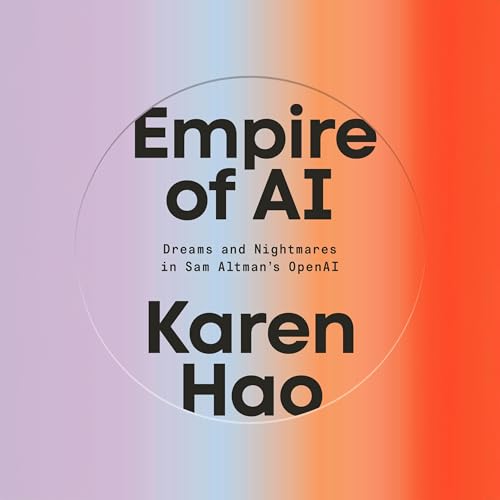
by Karen Hao
Book Details
• Genre: Investigative Journalism, Technology, Ethics
• Narrator: Karen Hao (varies by edition)
• Themes:
• The Ethics of Artificial Intelligence
• Corporate Power and Secrecy
• AI Safety and Existential Risk
• Idealism vs. Commercialization
• Leadership, Governance, and Influence in Tech
One-Sentence Summary
Karen Hao investigates the inner workings of OpenAI under Sam Altman’s leadership, exposing the high-stakes tension between idealistic AI safety goals and the relentless pursuit of dominance in an emerging technological empire.
Main Takeaways & Insights
• OpenAI’s Dual Identity
Founded on a promise of transparency and safety, OpenAI has gradually evolved into a corporate powerhouse with closed-door policies, reflecting the classic tension between mission and market.
• Sam Altman: Visionary or Strategist?
Altman’s leadership is portrayed as both inspiring and enigmatic—balancing a utopian vision of AI for humanity with decisive, calculated moves to corner the market.
• Ethics Colliding with Profit
The book outlines a growing internal and external conflict: how to develop safe, aligned AI while simultaneously racing for dominance in a space with minimal regulation.
• Secrecy Undermines Trust
As OpenAI shifts away from its originally open model, questions arise around who truly benefits from this technology—and whether transparency is still a priority.
• Empire Building in Real Time
AI development today mirrors the formation of geopolitical empires—where those who control information and infrastructure dictate global influence and future societal norms.
Key Quotes
“AI’s most powerful breakthroughs are being built behind closed doors.”
“OpenAI no longer just makes AI—it shapes how the world thinks about it.”
“The dream of shared progress is eroding beneath layers of NDAs and corporate firewalls.”
“Sam Altman’s empire is not just one of technology—but of narrative.”
“When machines learn faster than we can govern, trust becomes the first casualty.”
Personal Reflection
Empire of AI reads like a modern cautionary tale—a reflection on how revolutionary ideals can be warped by ambition and scale. Hao’s reporting is razor-sharp, posing questions that tech leaders often sidestep. It doesn’t vilify, but it does confront, pulling back the curtain on one of the most influential AI organizations of our time. Essential reading for anyone who wants to understand not just what AI is, but who controls its future—and at what cost.
