
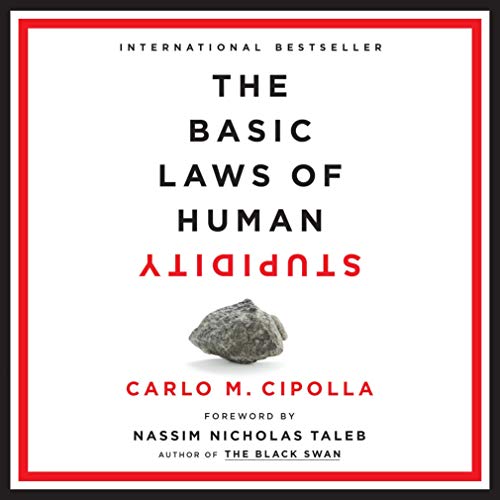
by Carlo M. Cipolla, with foreword by Nassim Nicholas Taleb
Book Details
• Genre: Psychology, Social Commentary, Behavioral Economics
• Narrator: Grover Gardner (audiobook edition)
• Themes:
• Defining and Recognizing Stupidity
• Human Behavior and Irrationality
• Social Consequences of Foolishness
• Misjudging Others’ Impact
• Power, Loss, and Collective Harm
One-Sentence Summary
Cipolla humorously yet sharply defines stupidity as a powerful and underestimated force that undermines both individuals and societies, warning that it poses greater danger than malice or greed.
Main Takeaways & Insights
• Stupidity Defined
A stupid person is someone who causes harm to others while deriving no personal gain—and may even suffer losses themselves.
• Five Universal Laws
Cipolla’s framework asserts that the proportion of stupid people is always underestimated, stupidity is independent of other qualities like education or class, and stupid individuals wield disproportionate destructive power.
• The Quadrant of Human Behavior
He classifies people as helpless (hurt themselves, help others), bandits (help themselves, hurt others), intelligent (help both themselves and others), and stupid (hurt others and themselves).
• The Danger of Stupidity Over Malice
Unlike malice, which can be predicted and countered, stupidity is irrational, making it more dangerous and difficult to guard against.
• Societal Collapse Factor
Cipolla argues that civilizations decline not primarily from enemies, but from the unchecked influence and actions of stupid individuals within.
Key Quotes
“Always and inevitably, everyone underestimates the number of stupid individuals in circulation.”
“A stupid person is more dangerous than a bandit.”
“The ability of a stupid person to hurt others depends on the position of power or authority he occupies in society.”
“Civilization is doomed when the number of stupid people is allowed to grow unchecked.”
“Intelligent people make mistakes, but stupid people persist in them.”
Personal Reflection
This slim but potent essay delivers more insight than many expansive treatises on human behavior. Cipolla’s blend of wit and brutal honesty makes the concept of stupidity both laughable and chilling in its implications. Taleb’s foreword underscores the timelessness of these ideas, particularly in modern contexts of misinformation, bad leadership, and systemic fragility. It’s a reminder that vigilance against stupidity is not elitism—it’s survival.
