
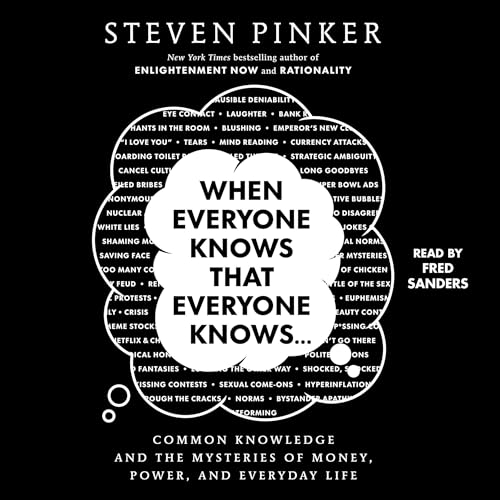
by Steven Pinker
Book Details
- Genre: Cognitive Science, Psychology, Social Theory
- Narrator: Fred Sanders (audiobook)
- Themes: Common knowledge vs. private knowledge · Social coordination and game theory · Strategic ambiguity and plausible deniability · Financial bubbles and political revolutions · Cancel culture and social media dynamics
One-Sentence Summary
Steven Pinker reveals how the shift from “everyone knows something” to “everyone knows that everyone knows it”—a state called common knowledge—silently governs our social, economic, and political lives in ways both liberating and dangerous.
Main Takeaways & Insights
- Common Knowledge Is Not the Same as Shared Information Private knowledge means A and B both know something. Common knowledge requires that A knows B knows, and B knows A knows—an infinite recursive loop of mutual awareness that fundamentally changes how people behave, coordinate, and act together. Pinker’s broader case for reasoning well is Rationality.
- It Enables Coordination Common knowledge is the invisible infrastructure behind everything from driving on the right side of the road to using paper currency to toppling a dictator—none of which can happen unless people trust that everyone else is on board.
- Humans Have a Sixth Sense for It Laughter, blushing, eye contact, blunt speech, and public declarations are biological and social mechanisms for creating common knowledge—turning private awareness into shared, irreversible certainty.
- People Also Work Hard to Avoid It Veiled bribes, sexual innuendo, diplomatic ambiguity, and polite hypocrisy all function as tools for keeping shared awareness just below the threshold of common knowledge—preserving plausible deniability and social fictions that hold relationships together.
- It Explains Cascades and Tipping Points Financial bubbles, sudden revolutions, and social media pile-ons all follow the same logic: once private dissent becomes common knowledge, collective behavior can shift catastrophically fast—exactly as when the child in The Emperor’s New Clothes blurted out what everyone already privately knew. Malcolm Gladwell’s The Tipping Point is the popular account of how such cascades spread.
Key Quotes
“With private knowledge, person A knows something, and person B knows it. With common knowledge, A knows something, and B knows it, but in addition, A knows that B knows it, and B knows that A knows it.” “Calling for complete honesty is the ultimate dishonesty. No one really wants it.” “It’s not enough that everyone knows something; it becomes common knowledge only when everyone knows that everyone knows.”
Personal Reflection
Pinker has written widely about language, rationality, and human nature, but When Everyone Knows That Everyone Knows may be his most quietly revelatory book yet. It illuminates a mechanism so embedded in daily life that most people never notice it—yet it governs how markets crash, how regimes fall, how relationships form, and why we blush. The recursive nature of the concept makes it intellectually demanding, but Pinker earns the effort: once you see common knowledge at work, you can’t unsee it. For anyone interested in why human cooperation is both staggeringly sophisticated and staggeringly fragile, this is essential reading.
Leave a Reply