
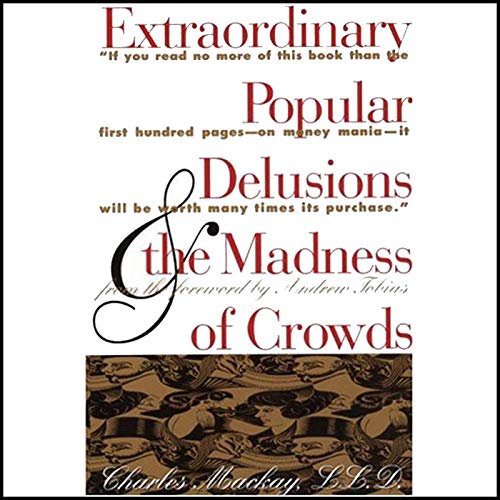
by Charles Mackay and Joseph de la Vega, edited by Martin S. Fridson
Book Details
- Genre: Financial History · Behavioural Economics · Investing Classics
- Narrator: Victor Bevine
- Themes: Speculative Bubbles · Crowd Psychology · Market Manipulation · Investor Discipline
One-Sentence Summary
Two old books set side by side — Mackay’s account of Europe’s great financial manias and de la Vega’s dialogues from the Amsterdam exchange — showing that speculative folly is not a modern invention but a standing habit of markets.
Main Takeaways & Insights
- Three Manias, One Shape The Mississippi Scheme of 1719, the South Sea Bubble of 1720 and the Dutch tulip trade of the 1630s run the same course — a plausible story, a rush of new buyers, prices that stop referring to anything, then a collapse that falls hardest on whoever arrived last. Mackay writes them as history rather than theory, and the repetition does the arguing for him.
- The Exchange Was Already Finished in 1688 Writing more than three centuries ago, de la Vega describes short selling, options, forward contracts, rumour campaigns and organised bear raids. None of the machinery needed inventing later.
- Borrowed Money Turns a Rise Into a Mania John Law’s paper currency and the instalment terms on South Sea subscriptions let people commit sums they did not hold. Credit is what separates an enthusiasm from a wreck.
- Respectability Sells Better Than Arithmetic Parliament, the crown and the French regency lent their names to schemes nobody had examined. Both books show crowds checking who else is buying rather than what is being bought.
- Temperament Beats Cleverness De la Vega ends with four rules for the shareholder, and not one of them is about picking well: never advise anyone to buy or sell, take your profits without mourning the ones you missed, treat exchange winnings as goblin treasure that can vanish overnight, and expect to need both patience and money. It is guidance about conduct, not analysis, and it is the most useful part of either book. Morgan Housel makes the same case for the individual investor in The Psychology of Money.
Key Quotes
“Every age has its peculiar folly” “Profits on the exchange are the treasures of goblins”
Personal Reflection
The unsettling part is not that people lost money in 1720. It is how reasonable each step sounds while you are reading it — the story holds together right up to the moment it doesn’t, and by then everyone respectable is already in. I caught myself thinking I would have seen it coming, which is the exact thought Mackay is warning about. De la Vega is the steadier of the two. He assumes you will be tempted, and tells you how to conduct yourself anyway; that is the part I expect to remember long after the tulips.
Leave a Reply